My second to last stop on my epic trip to Asia, which ended about a week ago, was Shanghai.
I wanted to see the "real" Shanghai, but the reality is not too exciting. So my first night on the Bund was spent at a chilly but efficient western-style coffee shop (Costa Coffee). As part of a chain, it was open until midnight. Everything else around was closed, and I didn't feel like going to a luxe hotel bar.
The very well-marked "old Shanghai". such as Hu Xing Tian tea house, in the historic yu yuan gardens, is charming. At Hu Xing Tian, where many take photos but few actually sit down, the entire interior is hardwood engraving and lacquerware. Once situated, I felt very much like someone in a Ming-era soap opera. I would have awesome hair coils and my scholarly escort would have a beard and a hat, not unlike some of the tea house's past patrons. Anyway, Eddie and I were both feeling a bit worn from jostling with the tourists and figuring out what to do next in the hustle-bustle. I thought some tea, however dear, would cheer us both up. The view was awesome!
Eddie ordered some green tea, which was a good choice for the weather. I chose the osmanthus longqian tea (62 RMB per cup), and felt vindicated when a cadre of visitors from Xi'An sat down at the table next to ours and ordered the same. I don't think I encountered any osmanthus flowers in Asia; at least if I did, I didn't recognize them. But I hear they smell like apricots. The resulting tea was worth every fen. The gardens themselves are well-kept. On the roofs of the enclosing walls and various pavillions, there are dynamic statues of archers, footsoldiers, and cavalry poised in attack or on the move.
Next to the koi ponds, full of very old fish, stood a giant statue of Hai Bao ("Sea Treasure") the friendly blue blob mascot of the Shanghai World Expo. There's a big emphasis on green and sustainable design for this year's Expo. Hai Bao is all-natural sea treasure.
Having read about the epic waits at the World Expo, I bought a small plastic stool that folds up in the huge market outside the gardens. It was a decent investment, I think.
The World Expo, I think we all agreed, was like a very informative version of Disneyworld. Long lines. Engaging posters and carefully suggested environments. A little passport that each guest can stamp at various cities and countries. Nearly all of the tourists I saw were Chinese. The World Expo 2010 is the first in which all of Africa's countries have participated at once. It is also the first World Expo I've attended. My group decided that we'd see as many pavillions as we could, rather than waiting four to six hours for the most popular pavillions.
The most impressive one I saw was Spain's. Having visited all of Spain's city cases (small rooms devoted to one city) on the other side of the river, I was able to fast-track it into the Spanish national pavillion. The outside was covered in some sort of wicker.
There was a live flamenco dancer (whose routine mercifully included lying down as though asleep) and some truly fantabulous movie montages on the inside. The films were like moving slideshows of photos of Spanish culture, from the 1800's onwards, sometimes overlaid with caricatures a la Monty Python. There was very little text; in fact besides brief blurbs on very broad versions of history or trade information, most cases and pavillions I saw were designed to give a general impression of the culture of a place. The general impression I took away from Spain's pavillion were: they have excellent fish, bulls, soccer, and cinematography. That sounds about right.
Indonesia's pavillion was also excellent, air-conditioned, and allowed for good traffic flow. There comes a point during the Expo where one considers line movement to be extremely important. There was a live band outside who sang with the verve of a mariachi band. The crowd loved it.
The Cambodian Pavillion was pretty cool and had scaled-down replicas of Cambodia's most famous temples.
Vietnam's very engaging pavillion proved that it's possible to construct flying buttresses out of bamboo. The look great. And puppets + knee-deep water = water puppet show.
Mongolia's pavillion included some pretty neat dinosaur fossils (small dinos, and eggs) and, of course, a statue of Jeffrey Goldblum being attacked by a dinosaur. JK I mean Genghis Khan. But in all honesty I was disappointed by the lack of info on gerbils, the friendliest animal you will ever encounter in the Gobi desert.
China's Pavillion is huuuuuuge. No picture can adequately describe how massive it is. It's going to hang around well after the Expo (along with, perhaps, Saudi Arabia's giant 4-D screen). Iunno.. is it kosher for one country to "gift" a pavillion to another?
The African Joint Pavillion worked well, although the quality of the individual country cases varied a lot.
Great Britain's pavillion was very fuzzy, thanks to the thousands of little things that covered it like a giant metal pincushion. Latvia's was imho the most pretty (it was covered in a swirl of sparkly shimmering glass). Morocco's looked like an actual palace, complete with moat and lily pond.
It was pretty cool to see so many parts of the world from one place.
Wednesday, July 28, 2010

Tuesday, July 27, 2010
Chengdu and Pandas
Many adventures ensued in Cambodia.
Next on the itinerary was China. And boy oh boy, was it a time.
Chengdu is where the wild things are. Wild, roly-poly things. The Chengdu Panda Research and Breeding Center in China's Sichuan Province is hands-down one of the best places in the world to see live pandas in large numbers. Getting up close and personal with the pandas allowed me to better understand these gentle creatures. Pandas demonstrate a deep and innate understanding of certain truths that we humans tend to ignore, such as, what is the best way to consume bamboo?
This lesser panda is enjoying bamboo leafy-side-up, which is to say, vertically.
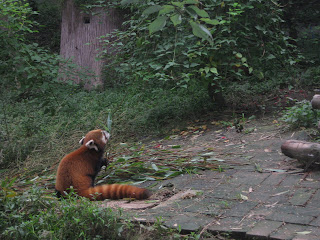 And here some bebe pandas are discussing their dinner plans.
 And here, a bebe panda uses the horizontal approach
 But regardless of whether you prefer your bamboo vertical or horizontal, proper table manners are important. If you see crumbs, look at them searchingly, try to eat them if you can, but ultimately accept that crumbs happen.

And lastly, what happens when the panda is tired of photo ops:
Next on the itinerary was China. And boy oh boy, was it a time.
Chengdu is where the wild things are. Wild, roly-poly things. The Chengdu Panda Research and Breeding Center in China's Sichuan Province is hands-down one of the best places in the world to see live pandas in large numbers. Getting up close and personal with the pandas allowed me to better understand these gentle creatures. Pandas demonstrate a deep and innate understanding of certain truths that we humans tend to ignore, such as, what is the best way to consume bamboo?
This lesser panda is enjoying bamboo leafy-side-up, which is to say, vertically.
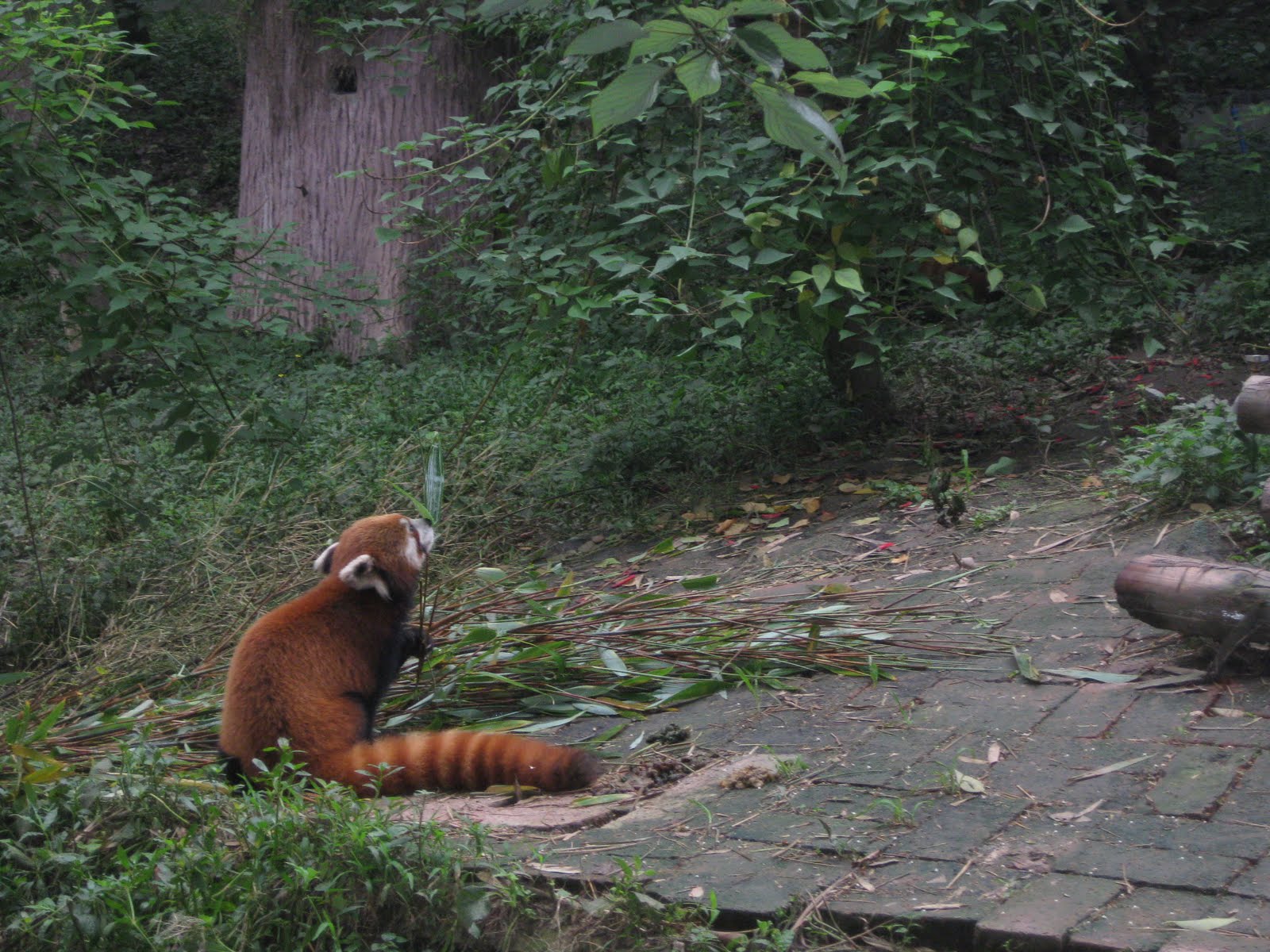 And here some bebe pandas are discussing their dinner plans.
 And here, a bebe panda uses the horizontal approach
 But regardless of whether you prefer your bamboo vertical or horizontal, proper table manners are important. If you see crumbs, look at them searchingly, try to eat them if you can, but ultimately accept that crumbs happen.

And lastly, what happens when the panda is tired of photo ops:
Random Acts of Kindness and a monkey
On our way back from Prey Chrouk, we hitched a ride with a man who was not a taxi driver. He was going to pass us, but he stopped and drove back to pick us up when he saw that we couldn't get a ride. We thought he might be a local, but he turned out to be a Cambodian American from Texas who owns a doughnut shop. His English was perfect. My friend Amy (who knows these things) later told me that many first-generation Cambodians in America take it upon themselves to open doughnut shops. I could not help replying, Who doesn't like doughnuts?
We found some company in his back seat. The little monkey was scared by our presence, but after we made no sudden moves, he calmed down and went to sleep.
 Now of course, there is a fair amount of skepticism that such an occasion might induce. To myself, I wondered what on earth this guy was doing with a monkey in his car. Capuchins, btw, are sometimes killed and eaten. But my gut told me that doughnut guy did not have monkey on the menu. We asked where he had gotten the monkey. He said he had seen the monkey held captive, tied to some post. He felt pity for it. Even a monkey, he said, deserved a better life than being tied up. So he bought the monkey from its previous owner and was now driving it to a temple, where he believed the monkey would find sanctuary with other monkeys. That made sense to me. Now he had picked us up and would be driving us to our destination.
I have never been so close to a monkey before without glass in between us. I was not scared though. The monkey looked like he had been through a lot and was just now able to fall asleep.
We talked with doughnut guy about the differences between Cambodia and America. Doughnut guy said that whenever he went back to Cambodia, he tried to do as much good as possible, because people in Cambodia wanted very much to work and to rebuild, but even so, they weren't being given opportunities. Corruption and job scarcity were hard to overcome, he said. He was lucky to be in America. If he helped people, maybe he could build up good karma.
When we bid our gracious driver farewell, he refused any payment. He said, It was no trouble. It's just nice to help someone. I'm not a taxi driver, so you don't need to pay me. We didn't expect that. I'm glad we bumped into him by chance.
Sunday, July 25, 2010
Teaching in Cambodia with iamcambodia
 Flowers brought to you by the letter awesome.
While reading about international issues while collating print-outs at my last job, I would often think to myself wistfully how wonderful it would be to volunteer overseas. Moral of the story: Just do it.
I spent a good chunk of time vetting non-profits in Southeast Asia. I wanted to work with an organization whose motives and operation were responsible and transparent, that didn't require more time or money than I could provide.
I ended up volunteering to teach English with iamcambodia.org, a volunteer-based charity that accepts donations for local schools in Cambodia. I paid for my personal expenses and a split a mere $6 a night for housing (which we paid directly to our host family, not the organization). I found iamcambodia to be effectively run and dedicated to directing resources directly to students and their families at very little administrative cost. It's not exactly a cushy gig, but I had a wonderful time.
We stayed with a lovely host family headed by a former Buddhist nun in Prey Chrouk Village, located about 45 km from Siem Reap. We shared quarters with new friends from Singapore (also volunteers), our hostess and her family. Among other things, our hostess showed us the proper way for eating delicacies such as fried cricket. How do you catch enough crickets for a good snack portion? With something like this, a cricket trap:

There is something refreshing about rising early to a rooster alarm, or perhaps a very displeased piglet. I loved being greeted every morning on the walk to school by Mr. Omnom, a cow possessed of a most magnanimous disposition, whose grazing radius crept ever closer to the school gate with each passing day, as though he were following us.
 As the English program at the Prey Chrouk schools is a recent venture, the students have less than a year's worth of English instruction behind them. All learn at their own paces; the secondary school children are extremely mature and respectful. The primary school children, ages 2 to 24, were more energetic and affectionate. Some would bring flower wreaths that they had made for me (pour moi? mais non!).
The secondary school children picked up things much more quickly, while teaching the primary school children required more thinking about pedagogy and development. While we started out assisting another teacher with his session, we were leading our own sessions by the end of the first day; it was an immersive learning experience for both the students and for us.
The students and the teachers really made us feel like we were welcome in their community.
One afternoon, another teacher invited us volunteers to attend a birthday party for a local village lady. We rode backseat on motorcycles along a bumpy path to a home a few kilometers from the school, past the fields where I students worked. I was astonished, as were my fellow volunteers, that such a lush, scenic scape of rice fields existed just behind our school. (Of course, we knew that many of our students tended to the fields during the half day that they did not go to school.)
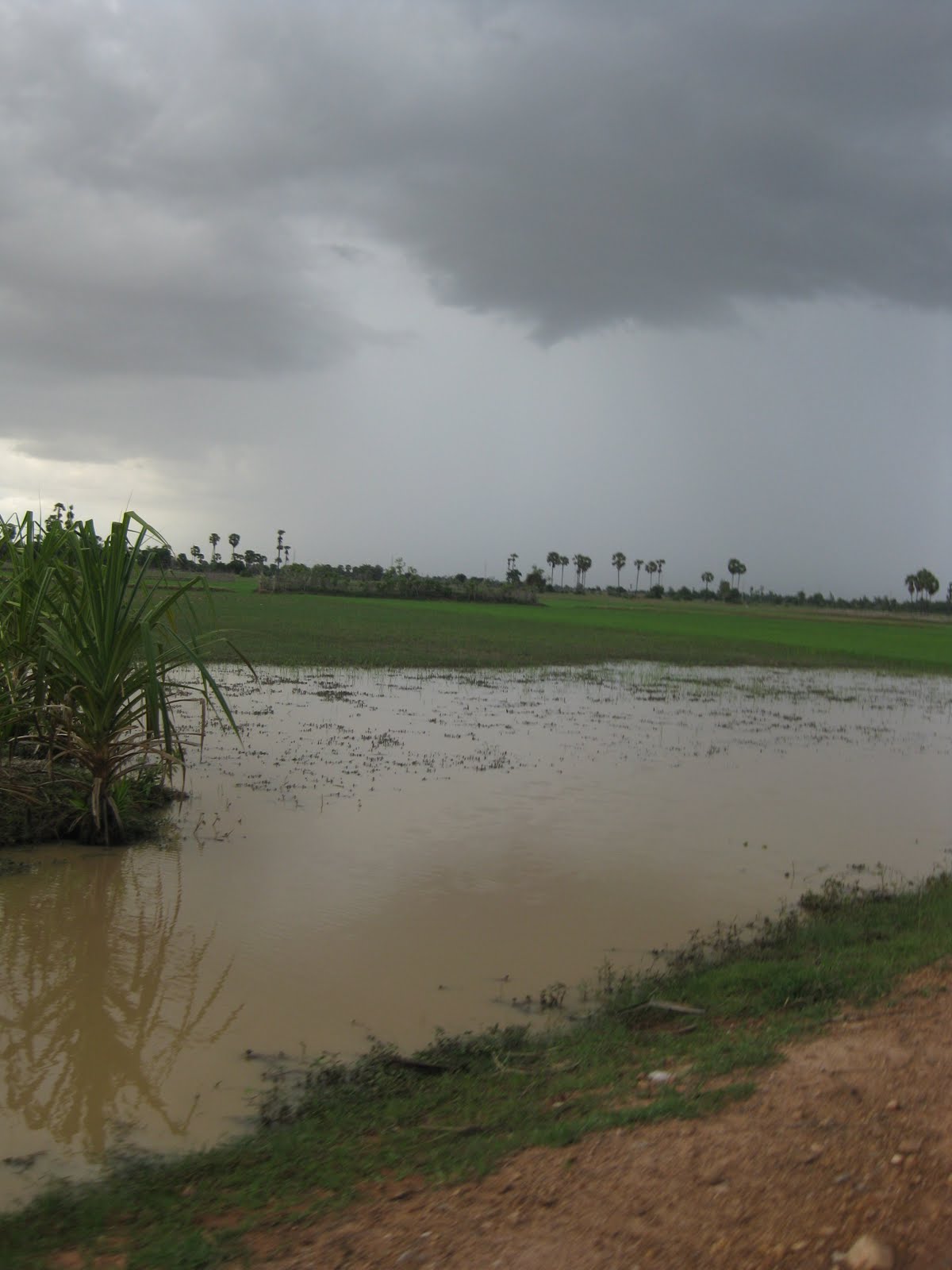 A bamboo pavillion over a tamped dirt floor was set up for the festivities. Someone had brought over a massive stereo. I cannot estimate the cost of such a party in real. The birthday girl was around 70, I'd say, but who knows? We all dug into bobor (rice porridge made with the whole chicken and onions, and I do mean the whole chicken) and cake (sweet fried wheat flour dough with sugar glaze), batting away insouciant flies and chatting with the other teachers. The villagers offered us a very strong, clear rice wine; it smelled like wax potatoes. We toasted to the birthday girl and hoped that our shy livers wouldn't fail us. For party favors, the birthday lady passed out large bars of chocolate wrapped in red paper. Sweet!
 Our dinner might not have looked like much, but I will never forget the festive spirit. We danced to traditional Khmer music and some newer tunes. Many songs in Khmer are sad love songs, but the night proved that even a place that loves ballads can spin some carefree jams as well.
Further down the road, we passed the homes of students at the school, who came out to greet our party with their parents. Everyone had their hands folded together, in a sign of respect.
It was definitely worth it.
Rilke
The following lines from Rainier Maria Rilke decorated a the wall that I often passed between college classes. It was in the building to the left of Harper (anyone from Hyde Park is welcome to correct me). I contemplated these words three times a week. When I was traveling, I would think of this poem, and feel that I understood it a little better because I was seeing so much outside of myself, yet I could never really escape the lens that was myself.
For the sake of a few lines one must see many cities, men and things.
 One must know the animals,
 one must feel how the birds fly and know the gesture with which the small flowers open in the morning.

One must be able to think back to roads in unknown regions, to unexpected meetings and to partings which one had long seen coming;
 to days of childhood that are still unexplained,
to parents that one had to hurt when they brought one some joy and one did not grasp it (it was joy for someone else);

to childhood illness that so strangely began with a number of profound and grave transformations,
to days in rooms withdrawn and quiet and to mornings by the sea,


to the sea itself,to seas,

to nights of travel that rushed along on high and flew with all the stars- and it is not enough if one may think all of this..."
At the charming Bookworm Cafe in Beijing's Sanlitun district, the last place where yours truly saw her beloved pink camera, I stumbled upon a poem of Rilke's once more. What do you like to read while wandering?
For the sake of a few lines one must see many cities, men and things.

 One must know the animals,
 one must feel how the birds fly and know the gesture with which the small flowers open in the morning.

One must be able to think back to roads in unknown regions, to unexpected meetings and to partings which one had long seen coming;
 to days of childhood that are still unexplained,
to parents that one had to hurt when they brought one some joy and one did not grasp it (it was joy for someone else);

to childhood illness that so strangely began with a number of profound and grave transformations,
to days in rooms withdrawn and quiet
 and to mornings by the sea,


to the sea itself,to seas,

to nights of travel that rushed along on high and flew with all the stars- and it is not enough if one may think all of this..."
At the charming Bookworm Cafe in Beijing's Sanlitun district, the last place where yours truly saw her beloved pink camera, I stumbled upon a poem of Rilke's once more. What do you like to read while wandering?
The twilight zone


Where can you find a helicopter AND a tank parked for eternity in front of a palace? In Saigon.
The former presidential residence of South Vietnam is preserved exactly as it was when the South surrendered to the North, thus bringing an official end to the Vietnamese civil war.


Underneath the lavish conference and dining rooms, there is a little basement maze of war rooms and even a secret stairway, to be used for a quick Presidential getaway.

The whole place feels a little bit like the set for an Alfred Hitchcock film, if Hitchcock filmed anything in Vietnam.
Saturday, July 24, 2010
Temples and Tombs in Vietnam


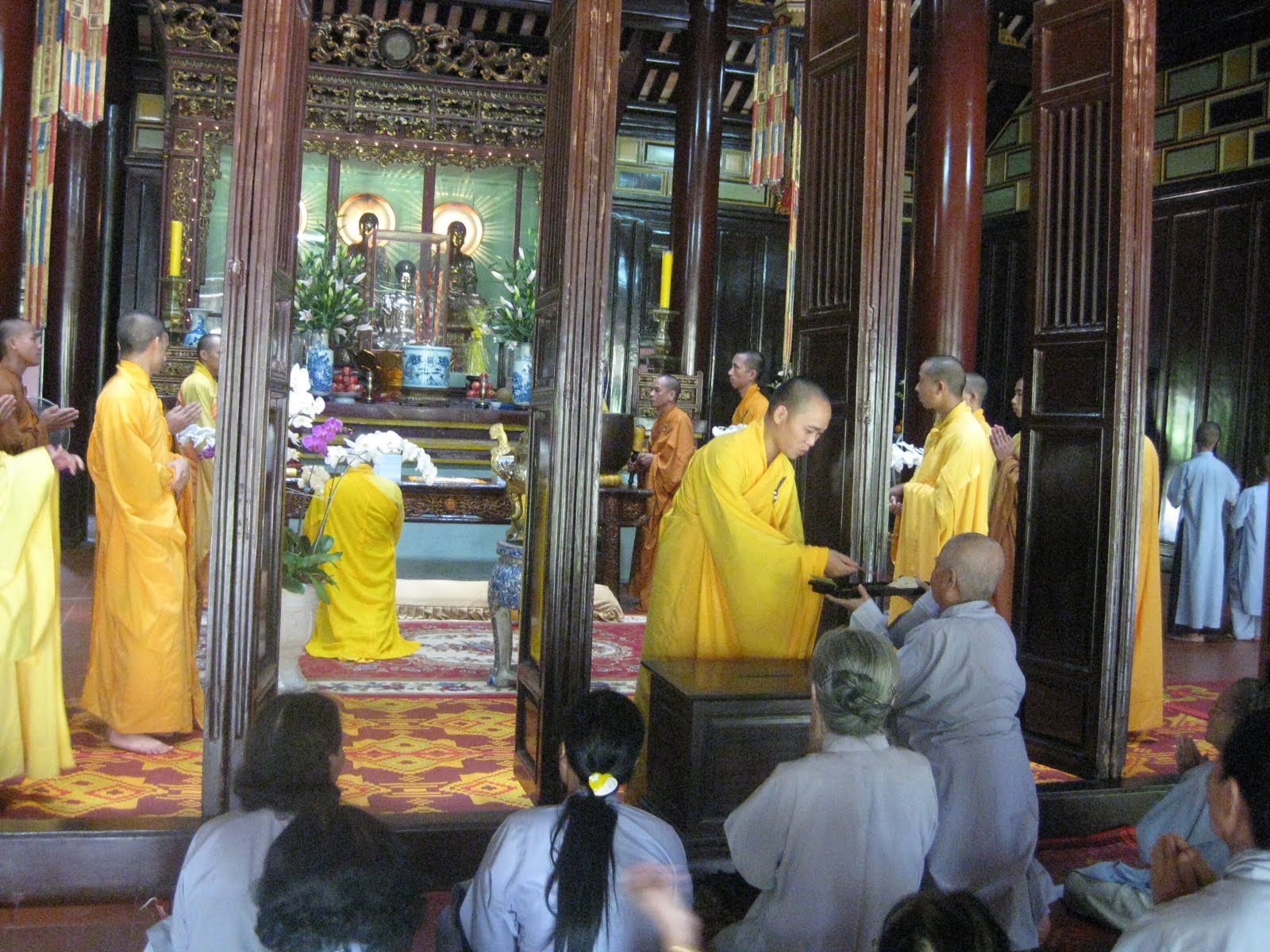
In Hue, one can find a veritable trove of pagodas and tombs from Vietnam's imperial past. Some places are quite alive. In one pagoda, we watched monks proceed in a circle, chanting sutras and ringing their distinctive bells. The eldest walked first, followed by students at the monastery. At the very end of the line walked the littlest students, no more than five or six, with their hair cut. It was a simple but moving ceremony. I felt lucky to be watching it. Here a monk near the front of the line is receiving an offering from an older lady.

Near this pagoda, which is hundreds of years old, an incongruous volkswagen beetle rests. It's actually a very sad memorial. A monk drove this vehicle to Saigon, where he staged a protest by self-immolation. It is hard to imagine so much sadness, stored in such a tranquil place.

Through the trees, we saw a group of young ladies in blue ao dai, chatting over lunch.
 Further on, we traipsed along the monuments of emperors past. Some have elaborate lotus gardens.

Other tombs display more elaborate interiors. Check out the mad wall mosaics. Yes that bird is 3-D.


Halong Bay, Vietnam
According to legend, Halong Bay was carved out of the rock by the thrashing tail of a dragon. Crossing the Bay requires a good breakfast, preferably one accompanied by a pond full of koi.
 On the good ship so-and-so, we set said for a winding 2-day journey through the bay. What makes Halong Bay really special is that the water is cut by many rough karsks. Some have caves or beaches that you can explore.


At night, the stars from the boat seem endless. The Vietnamese are very proud of this little slice of heaven, and for good reason.
More adventures from Cuc Phuong
Here are some images from Cuc Phuong I may have omitted
A turtle from the United States, whom the park rangers affectionately labeled kind of a nuisance because the species is so prolific:
A kitty! Who liked to wait by our feet as we dined on assorted ramen at the very fine little cafe in the park:
A GIGANTIC SNAIL
A turtle from the United States, whom the park rangers affectionately labeled kind of a nuisance because the species is so prolific:

A kitty! Who liked to wait by our feet as we dined on assorted ramen at the very fine little cafe in the park:

A GIGANTIC SNAIL

Good Morning Vietnam


Subscribe to:
Posts (Atom)